Exception Code Formatting
The Exception Code Formatting quality control (QC Quality Control) check identifies entries that contain invalid exception code formats, allowing for the correction of formatting issues to ensure exception codes are applied correctly.
 Required QC Prerequisites
To run this check, a feature with an exception field is required.
Configure QC Parameters
Configurations for QC check parameters contain filters to prevent selecting incompatible field types.
The following parameters can be specifically configured for the Exception Code Formatting QC check.
- Run On: Non-configurable. This QC check inspects the target dataset.
-
Severity: Sets the importance level of this QC check’s fallouts. Critical fallouts prevent export package outputs but will still provide fallouts.
-
Layer or Table Name: The name of the layer or table this QC check should inspect.
-
Reporting Unique ID: A unique identifier in the layer or table that can be used to uniquely identify a singular feature.
-
Exception Code Field or Column: The field or column that contains the exception codes for this layer or table.
What Does the Exception Code Formatting QC Check Output Include?
The following information is included for this QC check's fallout output.
- QC check name
- Description of the QC check
- Unique feature ID of the record with the invalid exception codes
- A list of invalid exception codes for the record
- Extended information providing more details about the fallout
- Latitude and longitude of the fallout's location (when applicable)
Examples - Fallout Report Records
The example below shows a possible error message you may receive when a record fails the Exception Code Formatting QC check. The extended information provides the value of the exception code that does not match the required format.

Note: When a layer has a configured exception code field, the ID automatically populates from the layer’s Global Unique ID for easier identification. When the global unique ID cannot be configured, the source object ID is used instead.
For accurate unique IDs when uploading multipart GIS Geographic Information System. A computer application that involves storing and manipulating electronic maps and related data. Also, mapping software combining spatial information about where places and events are located with data attributes describing those places and events. data, it is recommended that the Global Unique ID is always configured.
Examples - Issues Reported
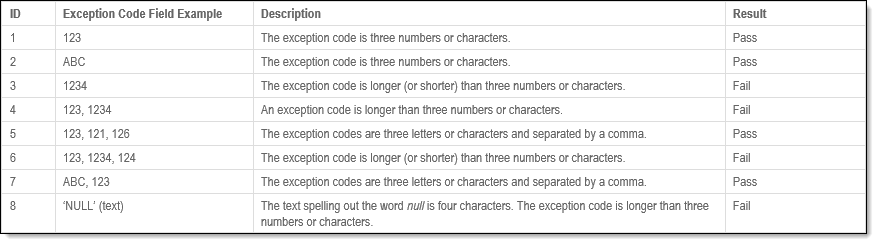
In this example, there are scenarios when running the QC check using the default exception code. The QC check results show the exception codes that were (pass) and were not (fail) formatted correctly.